
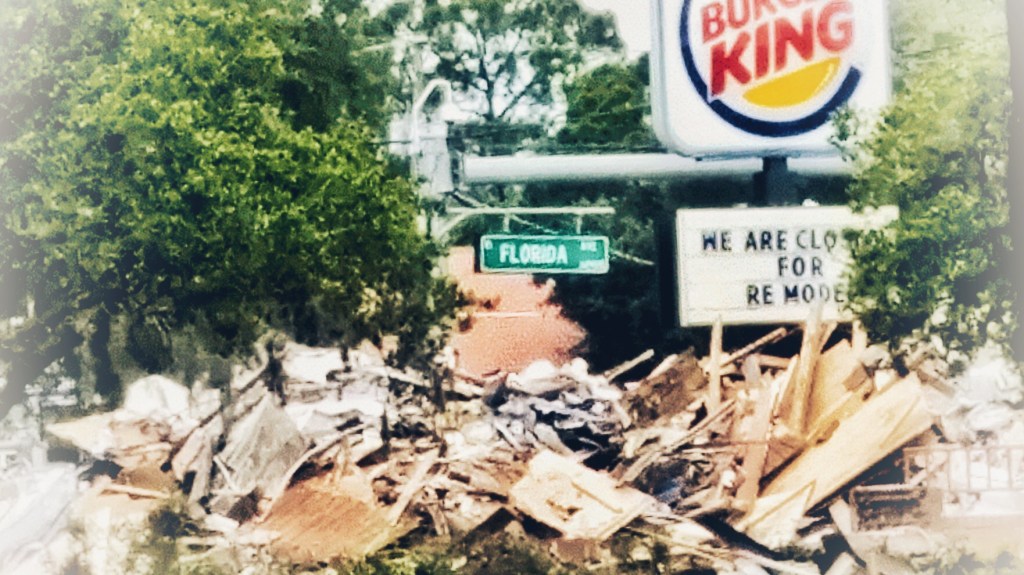
The day of the giveaway. They handed them out like party favors; matte green tubes, little ribbons, and a pamphlet stamped in cursive, “For Your Heritage.” The county fairgrounds became distribution centers, the civic centers pop up armories. The postman; bless his stripes, delivered not just bills but a heavy moral question in a cardboard box.
By nightfall, Orlampaland was forever changed. They called it Bazooka Day. Main Streets turned to obstacle courses. Neighborhood watch signs were swapped for laminated instructions;
“Aim at property, not people.”
Sidewalks cracked under the weight of craters. The logic, if you could call it that, seemed simple; if the Second Amendment was once about muskets single shot, awkward, profoundly inefficient then maybe the modern equivalent was the bazooka… still one shot at a time, just noisier, bigger, impossible to ignore.
And ignore it we could not.
A bazooka in every garage wasn’t a principled point about history; it was a practical mess. Collateral became shorthand for everything you once loved about downtown Lakeland. Cafés survived with murals painted on rubble. Orlando playgrounds echoed not with laughter but with zoning board announcements about structural assessments. Tampa’s waterfront looked like a canyon of concrete.
Citizens paraded their new status symbols in the name of heritage. Insurance companies formed prayer circles. Banks offered rubble loans. Realtors turned poetic
“Charming three bedroom near I-4; views of history and occasional demolition.”
The joke was cruel, but it worked. Nobody could deny the problem anymore.
Let’s step back from the smoke. If muskets were slow and bazookas are spectacular, both share one overlooked trait: the pause. You can’t rapid-fire either. There’s a beat, a reload, a space between action and consequence. That pause, once baked into the very technology of a musket, was lost when firearms evolved. Today, harm can be inflicted in seconds. The musket metaphor invites a thought experiment; what if we rebuilt pause into our culture and laws?
Waiting periods that turn impulse into deliberation.
Magazine limits that trade speed for reflection.
Background checks that filter crisis from catastrophe.
A cultural covenant that pairs rights with responsibilities; safe storage, training, and civic contribution.
The musket shows us the virtue of slowness. The bazooka shows us the cost of spectacle. Between the two lies the policy terrain of common sense.
By evening every street had a crater. By morning, silence.
That’s what stunned people most; the eerie calm of a city staring at itself across piles of its own handiwork. Children adapted first, turning scorched stop signs into thrones and zoning ordinances into treasure maps. Adults gathered in circles, debating whether to laugh, cry, or start hauling bricks.
And then; against all expectation, life reemerged.
Lakeland teenagers founded The Repair Co-op, swapping labor for lessons. Orlando mothers rewrote lullabies into work songs as they hammered nails. Tampa artists painted phoenixes on half-standing walls. Churches became blueprint libraries. Sidewalk cracks sprouted gardens.
Rubble Day became a holiday not of destruction, but of reckoning. Once a year, people swept streets, painted plywood, and retold the story of the day everything broke so badly that denial was no longer possible. The bazooka had been a metaphor, the rubble a mirror. What we did with that reflection was the real test.
Here’s where satire hands the microphone back to reality.
Gun violence in the United States kills more than 48,000 people a year, over half by suicide. It is not a fringe issue; it is a public health crisis. If Rubble Day forced the problem into the open, then the recovery forces us into solutions.
The evidence is clear. Background checks and waiting periods reduce impulsive harm. Extreme-risk protection orders (red-flag laws) save lives when crises erupt. Safe storage laws and programs cut down youth suicides and accidental shootings. Community violence intervention programs treat violence like a contagious disease and reduce shootings dramatically when funded and sustained. Creative buybacks transform dangerous items into community capital, especially when paired with housing help, tuition credits, or youth jobs. These are not fireworks. They are shovels, counseling sessions, and budget lines. They are the stubborn, quiet work of safety.
Imagine it in Orlampaland. Lakeland launching summer job programs in exchange for safe storage pledges. Orlando hospitals hiring intervention specialists who meet shooting survivors at the bedside with housing and counseling support. Tampa training judges, police, and families in how to use red-flag laws quickly, humanely, and fairly.
No rubble required.
What the bazooka gave us in metaphor, the shovel gives us in practice. Spectacle is easy. Repair is harder. But repair is what we choose if we want our porches, our parks, our Main Streets to be more than monuments to denial. Satire showed us the cracks. The musket reminded us of the pause. Rubble Day forced us to reckon with what happens when absurdity becomes policy. Now comes the work of building back without waiting for catastrophe. Because the truth, older than any amendment, is this; you cannot legislate away sorrow with spectacle. You can only build care into the places you love.
And so the final scene is not fireworks, but neighbors sweeping porches. Not grandstanding, but small, stubborn work. Plywood painted with hopeful letters.
THIS IS WHERE WE LIVE.
 Orlampaland
Leave a comment